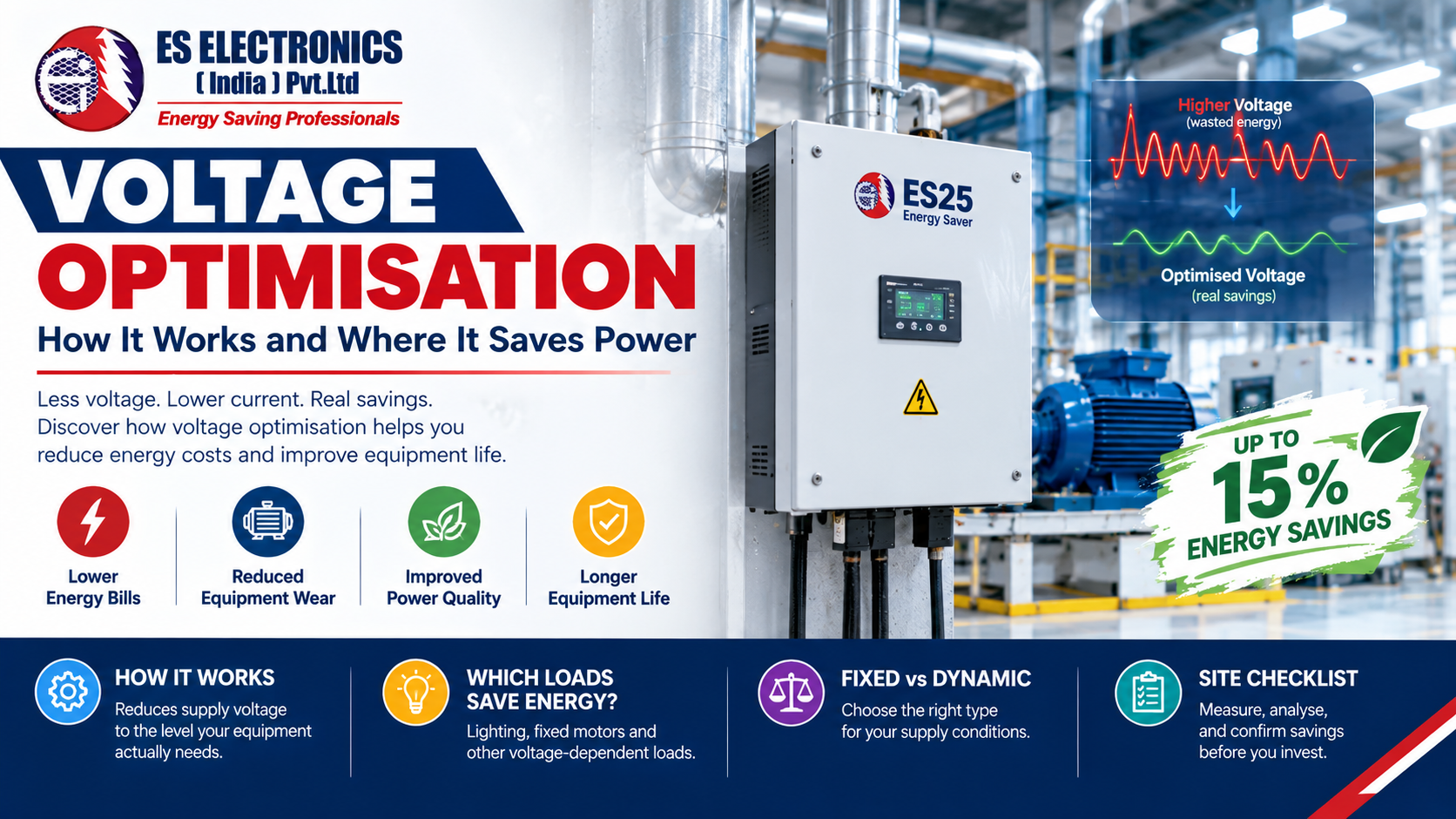
Many factories and commercial buildings receive more voltage than their equipment needs, and every extra volt is paid for in kilowatt-hours. Voltage optimisation trims that surplus, and an energy saver like the ES25 energy saver is built for exactly this job.
The catch is that not every load responds. This guide shows how the technology works, which equipment saves energy, which does not, and how to test your site before you spend.
The Short Version
• Savings come only from voltage-dependent loads such as older lighting and lightly loaded motors.
• LEDs, drives and IT equipment gain little or nothing.
• Fixed and dynamic units suit different supply conditions.
• Always measure before and after, on the same loads.
What Is Voltage Optimisation?
Voltage optimisation reduces the voltage supplied to your equipment toward the level it actually needs, while staying inside the manufacturer’s rated range. Lower voltage means lower current and heat on loads that respond to it, so the same work uses less energy.
The physics is simple. For many loads, power rises with the square of voltage. According to the Sustainable Energy Authority of Ireland, cutting supply from 240 V to 220 V could in theory save about 15% on loads that respond.
That figure applies only to those loads, never to a whole site, and real installations rarely reach the theoretical number. Your meter shows the total, so the real result is the saving on responsive loads blended with zero on the rest.
Which Loads Actually Save Energy?
Voltage optimisation saves energy only on voltage-dependent loads, which draw more power as supply voltage rises. Equipment with electronic control, such as LEDs and drives, holds its power constant and gains nothing.
| Load type | Response to lower voltage | Verdict |
|---|---|---|
| High-bay discharge lighting | Draws less power within its operating range | Likely to save |
| Fluorescent with inductive ballast | Draws less power, light output may dip | Likely to save |
| Fixed-speed motors, lightly loaded | Draws less power, torque falls | Possible, needs a check |
| LED lighting | Same power at any supply voltage | No saving |
| Motors on variable speed drives | Current rises as voltage falls | No saving |
| IT equipment | Constant power device, current rises | No saving |
| Thermostatic heaters | Needs fixed energy, runs longer | No saving |
The table follows the load classification in the SEAI measurement and verification guide, which also warns that each installation needs a case-by-case review.
Why Does Excess Voltage Waste Energy And Shorten Equipment Life?
Higher voltage pushes extra current through windings and ballasts, which turns into heat rather than useful work. That heat wastes energy and ages insulation, bearings and lamps faster than a well-matched supply would.
Supply voltage is rarely steady. It changes with grid load, transformer tap settings and the time of day, so a plant can see a high supply during lightly loaded night hours and a lower one at peak.
Because of that swing, a single voltage reading tells you almost nothing. Logging over several days or longer shows the real profile and the average excess you are paying for.
An energy audit records voltage, power factor and harmonics together, so you see the whole power quality picture in one visit. Repeat the readings in another season if your plant’s load changes with the weather, because the supply profile can shift too.
What Types Of Voltage Optimisation Exist?
Two types of voltage optimisation dominate: fixed and dynamic. Fixed units lower the incoming voltage by a set percentage, while dynamic units adjust continuously and also steady the output when the supply swings.
• Fixed: the simplest and most economical option, typically cutting a few percent off the incoming supply. It does not smooth out voltage variation.
• Dynamic: tracks the supply and holds the output near a target. It costs more but copes better with unstable networks.
Voltage control is one part of wider power quality improvement systems. Harmonic filters and power factor correction handle distortion and reactive power, which voltage reduction alone cannot fix. A good plan often combines them, with each measure chosen from measured data.
Not sure whether voltage control or another energy efficiency product suits your plant? Compare the options by load type first, then shortlist the ones that match your hours, your motors and your supply conditions.
How Can You Check If Your Site Is A Good Fit?
A site is a good fit when supply voltage runs above equipment needs and a large share of the load is voltage dependent. You confirm both with measurement, not assumption, using five simple steps.
1. Log voltage: record supply voltage at the main incoming point for at least a week.
2. List your loads: split lighting, motors, drives, IT and heating by type and share of consumption.
3. Check motor loading: find out which motors run lightly loaded and which run near full.
4. Check board capacity: make sure cables and protective devices can handle any extra current.
5. Estimate and verify: calculate expected savings, then confirm them with sub-meters.
If you prefer expert help, an auditor can run these steps for you and show which loads are worth targeting.
Where Does Voltage Control Pay Back Fastest?
Payback from voltage optimisation is fastest on sites with high supply voltage, long operating hours and a large share of voltage-dependent loads, such as older industrial lighting and lightly loaded motors. Sites with mostly LED and IT loads see little return.
Good candidates usually share these traits:
• Multi-shift plants with older high-bay discharge lighting
• Sites with many lightly loaded, fixed-speed motors
• Buildings where supply voltage stays high for much of the day
Poor candidates include LED-heavy offices, server rooms and plants where most motors already run on drives.
Tariff and operating hours matter as much as load type. A load that runs 20 hours a day repays a given saving far sooner than one that runs for four, so rank your loads by hours as well as by size.
Is An Energy Saver For Motors Safe To Use?
It can be, when the motor is oversized or lightly loaded. Torque falls with the square of voltage, so a heavily loaded motor can overheat or stall. Verify the real motor load before you install any energy saver for motors.
The SEAI guide gives a clear example. A 10% fall in terminal voltage cuts the torque of a standard induction motor by about 19%. That is acceptable at partial load and risky at full load or during hard starts.
For HVAC fans and pumps that run all day, a better route is often a different technology. EC fan retrofits for air handling units and cooling towers can cut HVAC energy by up to 50% by changing the speed rather than just the voltage.
If a motor runs close to full load for most of the day, leave its voltage alone. Look at speed control or an efficient replacement instead, and keep voltage reduction for motors that spend their time at partial load.
Also check starting duty. Compressors, crushers and conveyors that start under load need full torque, and a lower supply voltage can make those starts slow or fail altogether.
Treat every product of this kind as load dependent, and compare voltage optimisation with alternatives before you commit.
How Do You Verify The Savings After Installation?
Compare consumption on the affected loads before and after, adjusted for production, weather and operating hours. Sub-meters on a sample of each load type give the clearest answer, with the main meter as a cross-check.
Use a long enough baseline. Seasonal loads such as chillers and HVAC pumps need around six months of data, according to the SEAI guide, while loads that ignore the climate can use a shorter period.
IoT-based energy monitoring makes this routine easy, because dashboards and alerts show kilowatt-hours by load and flag any drift in voltage or consumption.
Frequently Asked Questions
Does it work with LED lighting?
No. LED drivers draw the same power at any supply voltage, so older discharge and inductive-ballast lighting is where gains come from.
Can lowering voltage damage equipment?
Not if the output stays inside each device’s rated range and motors are not heavily loaded. Check ratings and motor loading before installation, and re-check after commissioning.
What savings can I expect?
Voltage optimisation saves only on voltage-dependent loads, so results vary by site. ES Electronics quotes savings of up to 25% on suitable motor and distribution board loads, which you should confirm by measurement.
Is it the same as power factor correction?
No. Voltage control lowers supply voltage, while power factor correction reduces reactive power, and the two often work well together.
How fast is the payback?
It depends on your tariff, load mix and how much excess voltage you have. ES Electronics reports paybacks as short as one year for the ES25, and an audit gives a site-specific figure.
Does it affect IT equipment and drives?
These are constant power devices that draw more current at lower voltage. If IT makes up 30% or more of a site’s load, check that boards and protective devices can cope.
What Should You Do Next?
Voltage optimisation pays off when your loads are right and your supply runs high, so measure first and buy second. Our team works Monday to Saturday, 9:30 AM to 6:30 PM, so contact ES Electronics for a free consultation and share your voltage logs and latest bills.