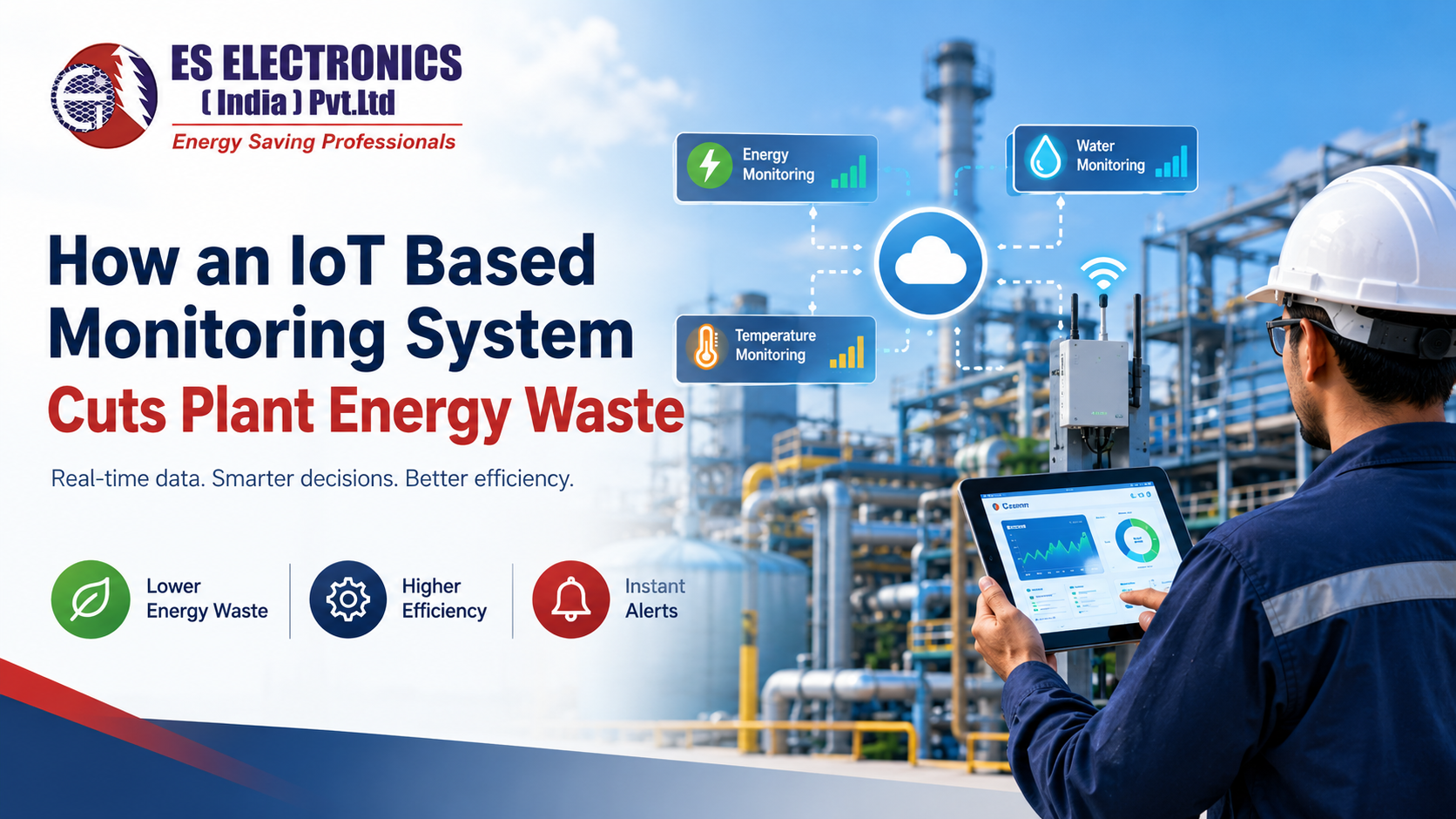
Most plants learn about a failing pump, a drifting power factor or a dark street light circuit only when someone walks past or the bill lands. A yearly energy audit captures one snapshot, and manual meter reading is slow.
An IoT based monitoring system replaces that guesswork with live readings from electrical, water and temperature points. This guide covers how it works, where it pays back, what drives cost, and how to roll one out without stopping production.
The Short Version
• Sensors, a gateway and a cloud dashboard turn field readings into live alerts.
• Offline mode keeps readings safe when the network drops.
• Motors, HVAC, pumps and lighting usually give the quickest returns.
• Cost follows the number of measurement points, not the size of the building.
What Is An IoT Based Monitoring System?
An IoT based monitoring system is a network of sensors, meters and controllers that send live readings of power, water or temperature to a cloud dashboard. Staff see trends on a phone or browser, receive alerts, and can switch connected loads remotely.
Almost every setup has four building blocks:
• Sensors and meters: current transformers, multifunction energy meters, temperature probes and flow sensors.
• Gateway: collects readings from field devices, often over Modbus, and forwards them over 4G or Wi-Fi.
• Cloud platform: stores history, applies rules and raises alerts.
• App and web dashboard: shows live values, trends and control buttons.
The value comes from the combination. A meter alone tells you what happened last month. A connected meter with rules and alerts tells you what is happening now, and who should act on it.
ES Electronics offers this as its CCMS IoT monitoring and control system, which covers energy, water and temperature points and can be added to older equipment as a retrofit.
How Does An IoT Monitoring System Work?
An IoT based monitoring system works as a four step loop: sense, view, control and act. Sensors capture live data, the dashboard shows trends, remote controls adjust loads, and alerts tell your team what needs attention before a fault becomes downtime.
• Sense: meters and probes read current, voltage, temperature, flow or tank level every few seconds.
• View: the dashboard plots those readings against time, shift and equipment.
• Control: schedules and remote switches turn loads on or off without a site visit.
• Act: alerts reach the right person by app or message when a reading crosses its limit.
Consider a pumping station that feeds an overhead tank. Without monitoring, a stuck float switch is found when the tank runs dry or overflows. With a flow sensor and a run time rule, the pump trips an alert within minutes and an operator can switch it off from a phone.
Offline operation matters in plants where mobile coverage inside a pump house or basement is patchy. ES Electronics lists offline mode among its platform features, so control and logging continue while the connection is down.
Which Loads Should You Monitor First?
Start with loads that run long hours and waste power quietly: induction motors, air handling units, water pumps and lighting circuits. They give clear baselines, visible alerts and the fastest return, so they make better first projects than small plug loads.
The table shows what an IoT based monitoring system typically tracks on each load, and the alert that makes the reading useful.
| Load | What gets measured | Typical alert |
|---|---|---|
| Induction motors | Current, voltage, power factor, run hours | Current rising at the same output |
| HVAC and air handling units | Power draw, supply and return temperature | Fan running outside its schedule |
| Water pumps | Run time, flow, tank level | Dry running or tank overflow |
| Street and car park lighting | Switch state, voltage, burning hours | Circuit failed to switch on |
| Distribution boards | Load, power factor, harmonics | Overload or power factor drop |
Rank the loads by annual energy use before you buy anything. A motor that runs 20 hours a day matters far more than a showroom light that runs four, even if the lights look easier to fix. Ranking keeps the first phase small and the first results easy to defend.
Motors deserve special attention, because live data shows whether a motor efficiency upgrade, such as a VFD panel or an IE5 retrofit, is delivering the savings it promised.
How Does Predictive Maintenance Reduce Downtime?
Predictive maintenance uses trends in current, temperature and run hours to flag a failing component before it stops the line. Instead of fixed service dates or breakdown repairs, your team acts when the data shows drift, which cuts surprise stoppages and wasted spares.
Three patterns are easy to spot once readings are logged:
• Rising winding temperature at constant load points to poor cooling or ageing insulation.
• Climbing current at the same output suggests bearing wear or a clogged filter.
• A pump that starts and stops every few minutes hints at a level or pressure control fault.
The same logic applies to schedules. Many plants discover that air handling units and compressors keep running through lunch breaks, weekends and night shifts. Once the dashboard shows run hours against the production calendar, switching them off on a timer costs nothing and the saving shows up in the next billing cycle.
Alerts also reduce arguments. When a technician and a supervisor look at the same trend line, a decision to service a machine rests on evidence, not on opinion.
HVAC gains a great deal from this approach, because EC fan and cooling tower retrofits can be tracked and adjusted remotely. ES Electronics quotes savings of up to 50% on such retrofits.
How Does An IoT Energy Monitoring System Support Audits And Compliance?
An IoT energy monitoring system records continuous load data that an auditor would otherwise sample by hand. That record helps verify savings, expose off hours consumption and supply the evidence an energy manager needs, though it does not replace a mandatory audit.
Under the Energy Conservation Act, designated consumers must get an audit done by an accredited energy auditor and appoint an energy manager, as the Bureau of Energy Efficiency explains.
An IoT based monitoring system gives that manager daily numbers instead of monthly bill totals. Facilities that are not designated consumers still benefit, because the same data shows where the biggest savings sit.
Continuous data also helps after an upgrade. Compare the weeks before and after a retrofit at the same production level, and the dashboard shows the real change in kilowatt hours. That evidence is far more convincing to a finance head than a vendor datasheet.
How Much Does An IoT Monitoring System Cost?
IoT monitoring system cost depends on the number of measurement points, the sensor types, the communication method and the software scope. A single pump house costs far less than a multi building campus, so scope the points first and price second.
When you request quotes, ask each vendor to price the same list of points. Otherwise one proposal may cover only meters while another includes alerts, mobile apps and remote control, and the totals cannot be compared.
| Cost driver | What changes the price | How to keep it down |
|---|---|---|
| Measurement points | Number of meters, CTs and probes | Start with your top ten loads by consumption |
| Connectivity | Wired RS485, Wi-Fi or 4G | Use one gateway per panel room |
| Platform scope | Dashboards, alerts, control features | Switch on alerts first and add analytics later |
| Installation | Retrofit on live panels or a new build | Schedule work around planned shutdowns |
ES Electronics states that most of its energy saving installations reach payback in under 18 months, and many qualify for up to 80% first year depreciation under the Income Tax Act. Confirm eligibility with your tax advisor.
A realistic budget for an IoT based monitoring system should also include a small allowance for commissioning and staff training, since a dashboard nobody checks saves nothing.
If your distribution boards already carry an ES25 energy saver, its optional 4G app based monitoring can serve as a low effort first measurement point.
How Do You Start An IoT Monitoring Pilot?
Start an IoT based monitoring system project with a short site survey, a ranked list of loads and a pilot on one panel room or pump house. Scale only after the pilot data proves the case to your finance team.
1. List your top ten loads by consumption using the last twelve electricity bills.
2. Survey panels, pump houses and mobile coverage on site.
3. Agree alert limits with your maintenance team, such as current ceilings and temperature bands.
4. Run the pilot for 30 to 60 days and compare readings with your manual logs.
5. Extend to the remaining loads and review alert history every month.
Name one owner for the alerts from day one. Alerts that go to a shared inbox tend to be ignored, while alerts routed to the technician who looks after that equipment get answered. Review thresholds after the first month, because early limits are usually too tight and create noise.
Frequently Asked Questions
Can an IoT monitoring system work without internet?
Yes, for local logging and scheduled control. A gateway with offline mode keeps working and syncs stored readings to the cloud once connectivity returns.
Do I need to replace existing equipment?
Usually not. Meters, current transformers and controllers attach to existing panels, so most plants retrofit without replacing motors or distribution boards.
What can it monitor besides electricity?
Water flow, tank levels and temperature. ES Electronics lists electrical, water and temperature monitoring on one platform, viewable on web and mobile.
Is IoT monitoring worth it for a small factory?
Yes, when power is a major cost. Monitoring your five largest loads often exposes waste quickly, and you can add points as the budget allows.
Who can see the data?
You decide. Good platforms offer role based access, so managers see dashboards while technicians receive alerts only for their own equipment.
How is predictive maintenance different from preventive maintenance?
Preventive maintenance follows calendar intervals. Predictive maintenance uses live condition data, so service happens when a trend shows wear, not simply because a date arrived.
Where Do You Go From Here?
Pick one pump house or panel room this month, list its loads and plan a pilot. For a tailored recommendation, talk to the ES Electronics team and book a site consultation.
A well scoped IoT based monitoring system pays back faster when it starts with data you already trust.