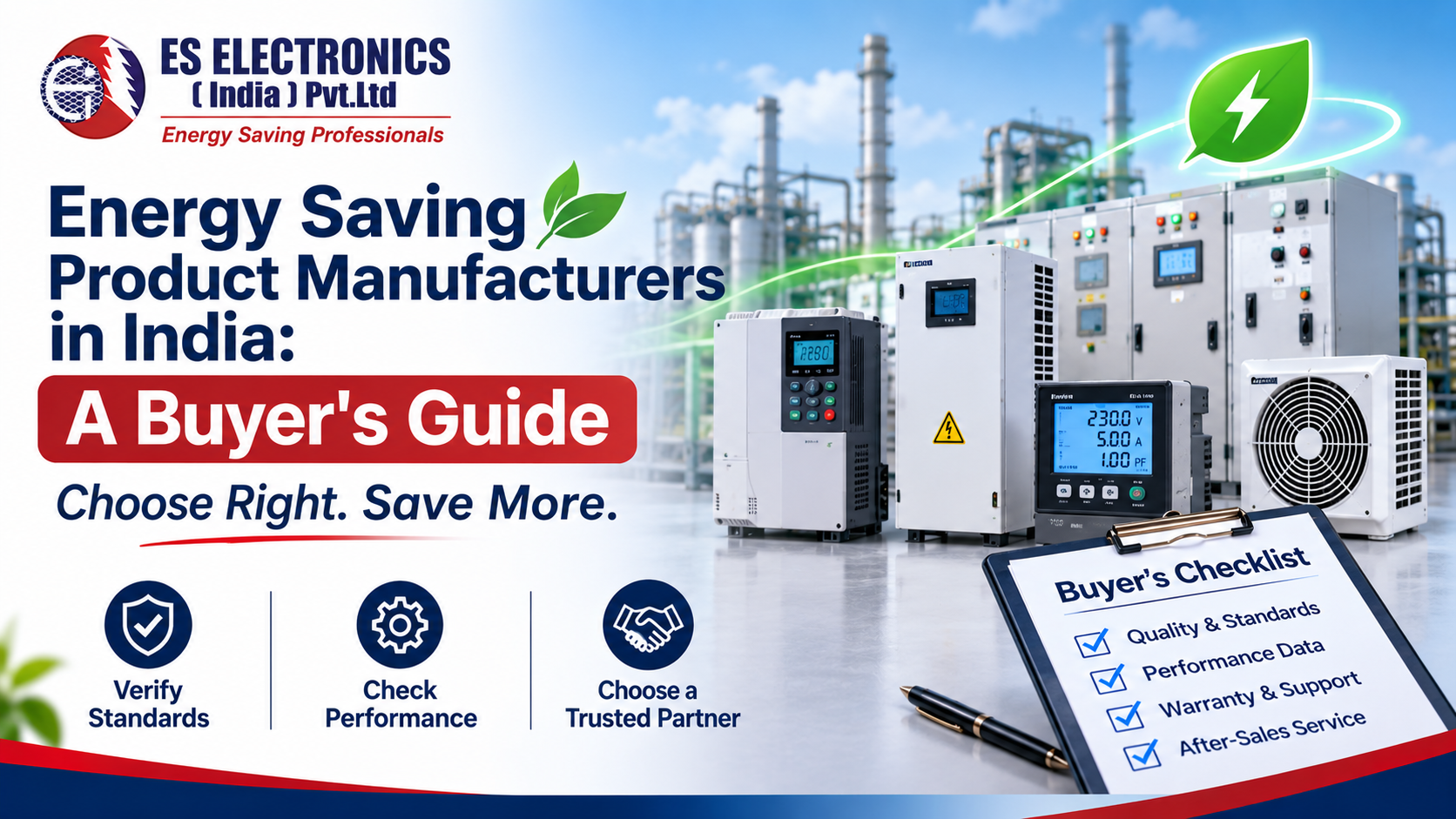
Buying an energy saver, a drive or a monitoring system is not like buying a bulb. The product has to work on your loads, survive your site and keep delivering for years. That makes the choice among energy saving product manufacturers a technical decision, not just a price comparison.
This guide gives you eight checks for comparing suppliers, whether you are a plant buyer in India or an importer abroad. For a look at one range, see our energy saving products and solutions.
The Short Version
• Separate manufacturers, traders and service companies, because each carries different risks.
• Treat ISO 9001 as proof of a process, not proof of savings.
• Ask for load-specific test data and site references with before and after readings.
• Check warranty, spares and local support before you compare prices.
What Do Energy Saving Product Manufacturers Make?
Energy saving product manufacturers build equipment that cuts electricity use, such as voltage optimisers, drives, power factor and harmonic equipment, EC fans, controls and monitoring systems. Each product works only on certain loads, so the match matters.
Typical energy conservation products fall into four groups:
• Electrical optimisation: voltage optimisers, power factor panels and harmonic filters.
• Motor and fan systems: drives, efficient motors and EC fan retrofits.
• Controls: timers, sensors and automation for lighting and HVAC.
• Monitoring: meters, gateways and software that show where energy goes.
Ask every supplier which load types its product suits and which it does not. A clear answer is the first sign of an honest manufacturer.
Should You Buy From A Manufacturer, A Trader Or An ESCO?
When comparing energy saving product manufacturers with traders, buy from a manufacturer for depth and support, from a trader for convenience on standard items, and from an energy service company for audit, supply, installation and verification in one contract.
| Supplier type | What they do | Strength | Watch out for |
|---|---|---|---|
| Manufacturer | Designs and builds the product | Technical depth, spares and customisation | May not install or verify savings |
| Trader or distributor | Resells products from several makers | Quick delivery, wide choice | Limited technical support |
| Energy service company | Audits, supplies, installs and verifies | One accountable partner | Check accreditation and contract terms |
ES Electronics is a BEE accredited energy service company with its own works unit in Bengaluru, so audit, supply and installation sit with one team.
Which Certifications And Standards Matter?
Look for ISO 9001 for the quality system, relevant product standards for the equipment, and market marks such as CE for export. For services, check BEE accreditation. Certificates support your decision but never replace testing.
ISO 9001 is a voluntary assessment of a management system against defined criteria, as TÜV SÜD explains in its guide to the ISO 9001 certification mark. It shows that a company controls its processes, not that every product performs.
Ask for product-level evidence too. That means test reports against the relevant IEC or Indian standard, and the certificate numbers you can check with the issuing body.
How Can You Verify Performance Claims?
Ask energy saving product manufacturers for load-specific test data, independent measurements and site references with before and after readings. A credible claim names the load types, the test method and the conditions.
Be careful with a single saving figure offered for every plant. For example, the ES25 energy saver is quoted at up to 25% on suitable motor and distribution board loads, and that is a ceiling for the right load mix, not a promise for all sites.
A good manufacturer welcomes a pilot. Install the product on one line, measure before and after on the same loads, and scale only if the numbers hold.
Define success before the trial starts. Agree the load, the duration, the measurement method and the saving that counts as a pass. Write it down, sign it and share it with the supplier, so nobody argues about the result afterwards.
Every energy efficiency product should come with a plain explanation of where it works and where it does not. If a salesperson cannot name the loads that will not respond, assume the rest of the claim is also loose, and ask for the claim in writing.
Where you lack data, start with an energy audit. It shows which loads respond to which product, so your specification asks for the right equipment.
What Should You Check In The Factory?
Visit the factory, or request a video audit, to see incoming inspection, assembly, test benches and records. A good works unit shows controlled processes and traceable components for energy saving product manufacturers of any size.
• Incoming inspection: how components are checked before assembly.
• Assembly: clean, labelled and consistent workmanship.
• Test bench: every unit tested before dispatch, with records kept.
• Calibration: instruments calibrated on a schedule.
• Traceability: serial numbers linked to components and test results.
• Spares: stock of key parts for service.
Ask to see a failed unit and the corrective action that followed. How a manufacturer handles faults reveals more than a clean showroom. Also ask how often the same fault has returned, and what changed in the design or process to stop it.
What Warranty, Support And Spares Should You Expect?
Reliable energy saving product manufacturers give a written warranty, a named service contact, spares availability and a response time you can hold them to. Support after sale decides whether savings last beyond the first year.
• Warranty: length, what it covers and what voids it.
• Service: engineers who can reach your site, with clear response times.
• Spares: stock locations and typical delivery time.
• Training: operator and maintenance staff briefed at handover.
• Software and firmware: update policy for monitoring products.
What Should Importers And Power Saving Products Exporters Check?
Importers and power saving products exporters should check voltage and frequency compatibility, destination market certifications, documentation, packing, spares and payment terms. Products built for 50 Hz and 415 V may need changes elsewhere.
Confirm the ratings that matter for your grid, such as supply voltage, frequency and earthing system. Then check which local marks the destination market requires, and who holds the technical file.
Agree documents in advance: test reports, packing lists, labelling, user manuals in the right language and commercial terms. Plan after-sales support through a local partner, or confirm remote support in writing.
How Do You Compare Total Cost Instead Of Price?
Compare total cost of ownership: purchase price, installation, commissioning, service, spares and the savings you can verify. A lower price with weaker support often costs more by year three.
Build a simple three-year view for each supplier. Include delivery and installation, expected service visits, spare parts and the energy saved on your own tariff. Then divide by the saving to get payback on your numbers, not the supplier’s.
Ask each supplier to state the assumptions behind its payback figure. If the assumptions are hidden, the figure cannot be trusted.
How Should You Run A Fair Supplier Comparison?
Score each supplier against the same criteria, weighted by what matters to your project. A simple scorecard exposes gaps that a price list hides.
1. Shortlist: pick three suppliers that meet your basic technical needs.
2. Send one specification: include load types, ratings, standards and site conditions.
3. Score: rate certification, test data, references, support and total cost.
4. Pilot: trial the leading product on one load.
5. Verify: measure savings with sub-meters or IoT-based energy monitoring.
What Mistakes Should You Avoid?
The common mistakes are buying on price, trusting a certificate alone, skipping a pilot, ignoring support and accepting vague savings claims. Each one is easy to avoid with a short written specification.
• Price only: the cheapest unit often lacks testing, support or spares.
• Certificate only: a management system certificate does not prove product performance.
• No pilot: a small trial prevents a large mistake.
• No support plan: a product without service becomes an expensive ornament.
• Vague claims: insist on named loads, methods and conditions.
Frequently Asked Questions
How do I know a manufacturer is genuine?
Check company registration, certificate numbers with the issuing body, factory access and customer references you can call. Genuine energy saving product manufacturers share these willingly.
Is ISO 9001 enough?
No. It shows a controlled quality system, not product performance on your loads, so ask for test reports and site data too.
Can I get a trial unit?
Many suppliers support pilots, but terms vary. Agree the load, duration, measurement method and success criteria in writing before the trial starts.
What warranty should I expect?
Terms differ by product, so compare them in writing. Check the length, what is covered, who services it and how fast they respond.
Can I import from India?
Yes, but check destination certifications, voltage and frequency, documentation and support. Ask about technical files and local service before you order.
What should I send for a quotation?
Send load types, ratings, supply voltage and frequency, running hours, standards required and site conditions. Better data produces a better recommendation.
What Should You Do Next?
Write a one-page specification, then ask your shortlist of energy saving product manufacturers to quote against it. Our team works Monday to Saturday, 9:30 AM to 6:30 PM, so contact ES Electronics for a free consultation and share your load list and latest bills.