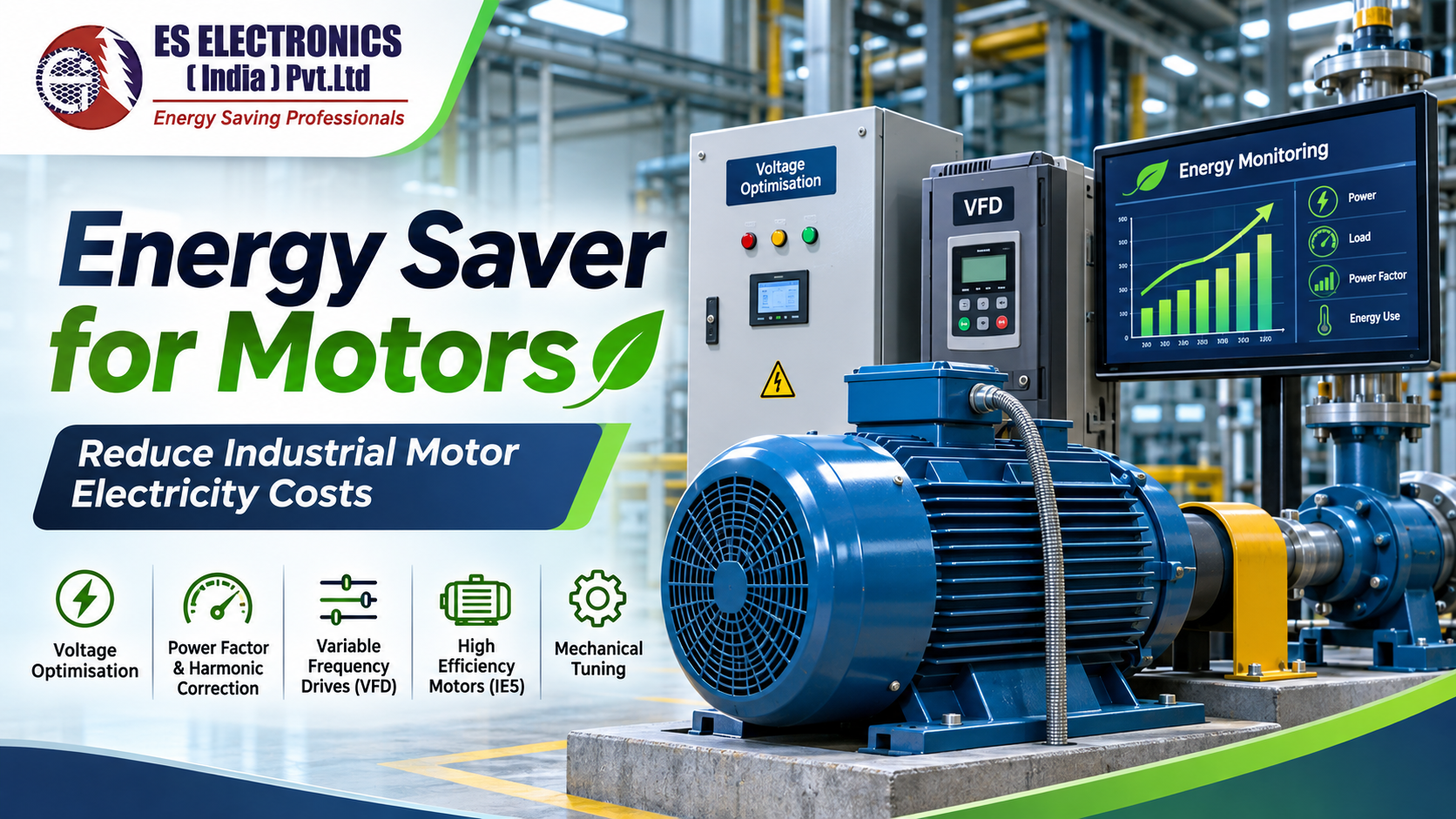
Motors use most of the electricity in a typical factory, yet many plants run them with no efficiency measures at all. Before choosing equipment, run an industrial energy audit to learn which motors are lightly loaded, poorly supplied or running when nobody needs them.
This guide explains how an energy saver for motors works, which options suit which loads, and how to prove the savings are real.
Quick Answer
• Motor systems use about 72% of industrial electricity worldwide.
• Savers, drives and IE5 upgrades each suit different loads.
• Lightly loaded and variable speed motors respond best.
• Measure load, power factor and harmonics before you buy.
What Does An Energy Saver For Motors Actually Do?
An energy saver for motors is a device or upgrade that cuts the electricity a motor draws for the same mechanical output. Depending on the type, it trims excess voltage, corrects power factor, filters harmonics or slows the motor to match demand.
No single product fits every motor. A constant speed pump, a lightly loaded conveyor and a compressor with long idle periods lose energy in different ways, so they need different fixes. That is why the choice starts with the load, not the catalogue.
Four mechanisms cover most products on the market:
• Voltage optimisation on the supply side
• Power factor and harmonic correction
• Speed control with variable frequency drives
• Higher efficiency motors such as IE5
Why Are Motors Such A Big Share Of Your Power Bill?
Electric motor systems account for about 72% of industrial electricity use, according to the IEA 4E motor systems platform, because they drive pumps, fans, compressors and conveyors. A small gain on that scale is worth far more than the same gain on lighting.
Knowing how to save electricity on industrial motors starts with knowing where they waste it. The usual causes are:
• Oversized motors running far below rated load
• Flow throttled by valves or dampers instead of speed control
• Motors left running while the process is idle
• Supply voltage above what the motor needs
• Worn belts, misaligned couplings and failing bearings
Most plants have several of these at once. Each one points to a different fix, which is why a single purchase rarely solves everything.
A useful habit is to sort motors by annual energy use, not by horsepower alone. A modest motor that runs around the clock can cost more to operate than a large one used for an hour a day, and it deserves attention first.
Which Motor Energy Saving Options Work Best?
The right energy saver for motors depends on how the motor is loaded and what it drives. Voltage optimisers suit steady mixed loads, drives suit pumps and fans, IE5 upgrades suit motors that run long hours, and star delta changeover suits lightly loaded starters.
| Option | Best for | How it saves | Watch out for |
|---|---|---|---|
| Voltage optimiser or energy saver | Mixed motor and lighting boards | Trims excess voltage and improves power quality | Little gain on fully loaded motors |
| Variable frequency drive | Centrifugal pumps and fans | Slows the motor to match demand | Harmonics and motor suitability |
| IE5 motor upgrade | Motors that run long hours | Higher efficiency, flatter part load curve | Upfront cost and frame fit |
| Automatic star delta changeover | Lightly loaded three phase motors | Runs in star connection at low load | Needs a suitable duty cycle |
| Power factor and harmonic correction | Plants with drives and electronic loads | Cuts reactive power and distortion | Must be sized from measurements |
| Mechanical tuning | Any motor | Fixes belts, alignment and bearings | Gains are modest but cheap |
ES Electronics lists ES25 energy savers, VFD panels and IE5 retrofits in its motor and energy saver product range, so one survey can compare them side by side.
When Does Voltage Optimisation Help A Motor?
Voltage optimisation helps most when supply voltage runs above what the motor needs and the motor is only partly loaded. A well chosen energy saver for motors lowers that excess, which cuts losses, while a fully loaded motor needs its rated voltage and gains little.
ES Electronics reports savings of up to 25% on motor and distribution board loads with its ES25 unit, and cites payback that can be as short as one year. Treat both as upper figures. Your load mix sets the real result.
Test before you buy. Log voltage, current and power factor on each board for at least a week, covering every shift.
Also check the incoming supply. Utility voltage often swings with the time of day, and a saver that suits the average may still need to cope with the extremes. Ask any supplier how the unit behaves at the low and high ends of your range.
Signs that a saver may help:
• Supply voltage sits above the nameplate value for long periods
• Motors run well below rated load
• Boards carry a mix of motors and lighting
• Power factor or harmonics readings look poor
How Do VFDs And IE5 Upgrades Compare?
Drives save energy by slowing a motor when demand falls, so they suit pumps and fans where flow varies. IE5 upgrades raise efficiency at every load, so they suit constant speed machines that run long hours. Many plants combine both.
For centrifugal loads, power falls with the cube of speed, so a 20% slowdown can nearly halve power draw. Real results are lower once drive losses and minimum flow limits apply.
An IE5 motor retrofit works differently. It replaces an older motor with a high efficiency design whose advantage holds up at part load, which matters because most motors seldom run at nameplate output.
Drives add harmonics, so budget for filtering or a clean supply. The same speed control principle powers EC fan retrofits for air handling units, a good example of matching airflow to demand.
Choosing between the two usually comes down to the duty cycle. A pump that spends half its time at reduced flow is a drive candidate. A grinder or crusher that runs at constant output for sixteen hours is closer to an upgrade candidate.
Both options need correct sizing. An oversized drive wastes money, and a motor replaced without checking its real load can end up just as oversized as the one it replaced.
Staged projects work well here. Many plants start with the cheapest high return fixes, then fund drives and motor replacements from the savings.
How Do You Keep Motor Savings From Fading?
Track each motor’s power and condition after installation. A motor energy saver, drive or upgraded motor can drift from its baseline as loads, belts and bearings change, and only continuous data shows when it has.
For an energy saver for motors to keep paying back, log kilowatt hours, current and run hours before and after, then review them monthly. IoT based monitoring with motor predictive maintenance raises alerts when a motor leaves its baseline.
Useful numbers to watch for each motor:
• Energy use per shift or per unit produced
• Running current against the nameplate rating
• Power factor and voltage at the terminals
• Idle run hours
Give one person ownership of those figures. A short monthly review catches drift long before the bill does.
How Do You Choose And Install One Step By Step?
Choose an energy saver for motors in six steps: list the motors, measure them, rank by savings, match the option to the load, install, and verify. The order matters because measurement decides which product, if any, each motor needs.
1. List every motor above a chosen size with its rating and duty hours.
2. Measure voltage, current, power factor and harmonics under normal load.
3. Rank motors by annual energy use and likely savings.
4. Match each motor to a saver, drive, upgrade or no change.
5. Install in ranked order, starting with the largest opportunities.
6. Compare results with the baseline and keep monitoring.
Involve maintenance early. Starters, protection settings and drive compatibility are easier to plan than to repair later.
Frequently Asked Questions
How to save electricity on industrial motors?
Match speed and voltage to the load, correct power factor and harmonics, switch off idle motors, and keep belts and bearings in order. Measure first so spending goes where it counts.
Does an energy saver for motors work on every motor?
No. An energy saver for motors gains most on lightly loaded motors and mixed boards, and little on fully loaded machines, so measure to see which of your motors qualify.
How much can motor upgrades save?
ES Electronics reports up to 25% with ES25 on motor and distribution board loads, while drives on variable pumps and fans can save more. Your load profile sets the real figure.
Is a VFD better than an energy saver?
They solve different problems: a drive suits variable flow pumps and fans, while a saver suits steady loads and supply quality issues. Many plants use both.
Will these products affect motor life?
Properly selected equipment should not harm motors. Check drive compatibility and harmonic limits, and follow the manufacturer’s guidance for each model.
Do you need an energy audit first?
An audit shows motor loading, power factor and harmonics together, so you buy the right product once. A preliminary audit is enough to begin.
Where Do You Go From Here?
Start with measurement. Book an energy audit with ES Electronics to map your motor loads, then match each one to a fix. The right energy saver for motors is the one your own data supports.