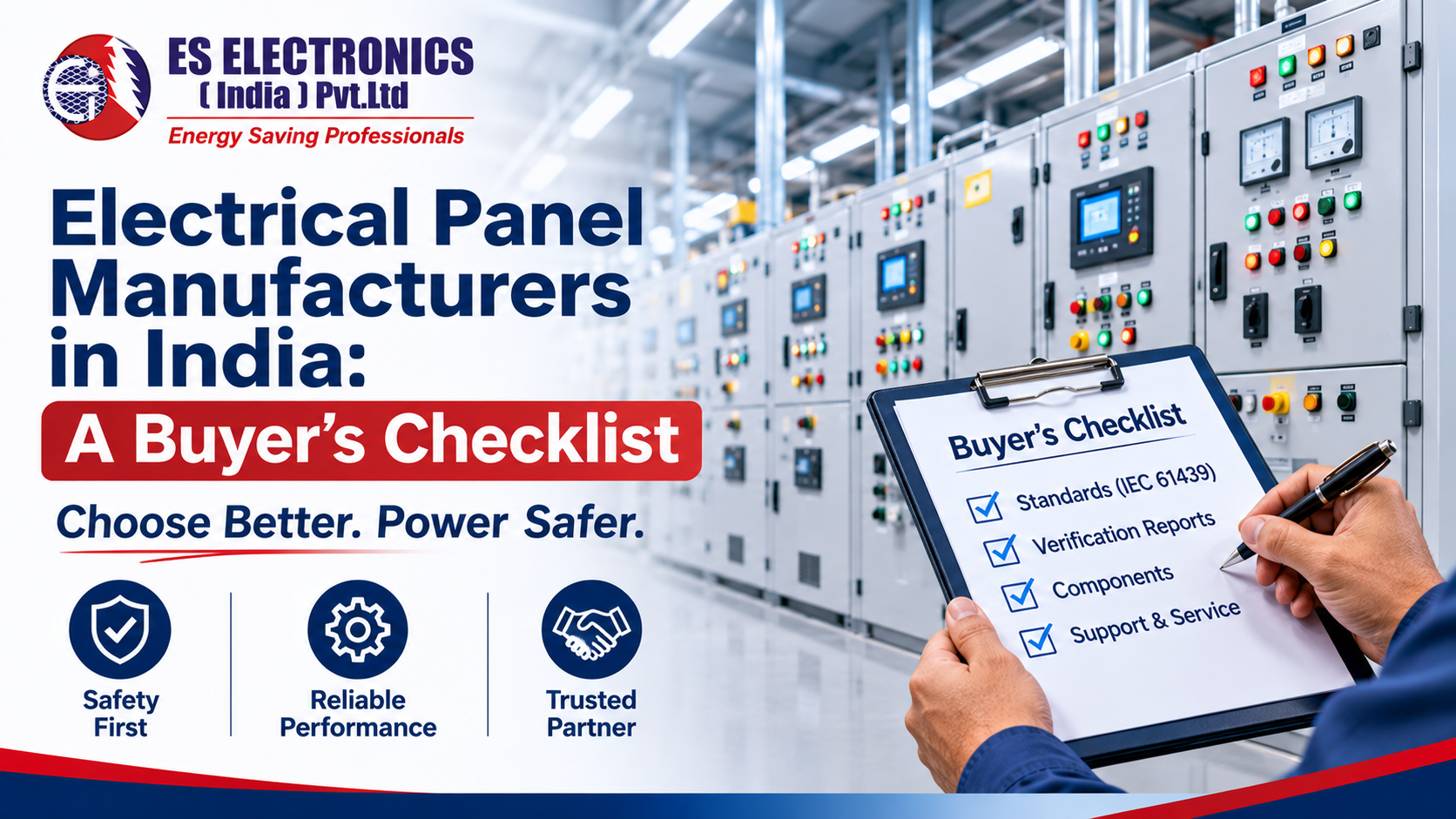
A panel sits at the heart of every plant, yet many buyers choose it on price and lead time alone. The cheapest quote can hide thin busbars, untested designs and missing paperwork.
This guide shows how to compare electrical panel manufacturers on facts that protect people, uptime and your budget.
ES Electronics also supplies electrical distribution panels alongside its audits and energy conservation products.
The Short Version
• Ask whether the design is verified to IEC 61439, and ask to see the paperwork.
• Every panel should leave the factory with its own routine verification report.
• Compare quotes on ratings, busbars, enclosure, components and documents, not price alone.
• Plan space and metering for energy monitoring before the panel is built.
What Do Electrical Panel Manufacturers Actually Build?
Electrical panel manufacturers build assemblies of switchgear, protection, metering and control devices inside a metal enclosure, which distribute power safely to your loads. Each panel type does a different job in the plant.
| Panel type | What it does | Typical use |
|---|---|---|
| Main LV switchboard | Receives incoming supply and feeds sub-boards | Plant or building main incomer |
| Motor control centre (MCC) | Starts, protects and controls groups of motors | Pumps, fans, compressors, process lines |
| Power distribution board | Splits supply across feeders and final circuits | Floors, blocks and utility areas |
| APFC panel | Switches capacitor banks to correct power factor | Plants with a lagging power factor |
| Control and VFD panels | Hold drives, PLCs and control gear | Machines and process automation |
Parts of the same standard cover many of these. IEC 61439-2 covers power switchgear and controlgear assemblies such as switchboards and MCCs, while part 3 covers distribution boards.
Which Standards Should A Panel Builder Follow?
Reputable builders follow IEC 61439, the international standard for low-voltage switchgear and controlgear assemblies. It replaced IEC 60439 and became valid exclusively from 1 November 2014.
The standard separates two jobs. Design verification proves that a design meets the standard, and it is made up of 21 individual verifications. Routine verification checks that each finished panel matches that design.
Short-circuit withstand strength and temperature rise are the most demanding verifications. A component maker’s explainer on the IEC 61439 design and routine verification roles adds that the standard is a recommendation rather than law, but it records the accepted safety requirements.
In India, check which Indian standard adoption your specification names, and ask the builder to state it in the quotation.
What Should You Check Before Choosing A Panel Builder?
Before you shortlist electrical panel manufacturers, check seven things: verified design, routine reports, component ratings, workshop capability, drawings, references and after-sales support. Each one separates a controlled factory from a fabrication shop.
• Verified design: ask for the design verification summary, or the original manufacturer’s system documents.
• Routine reports: a signed report for every panel, not a generic certificate.
• Components: named makes, with ratings that match the design.
• Workshop: sheet metal, busbar fabrication, wiring and finishing under one roof.
• Drawings: general arrangement, single-line diagram and bill of materials before fabrication.
• References: similar projects you can visit or call.
• Support: spares, service visits and response times.
Start with the panels you already have. An electrical safety audit and energy audit shows which boards run hot, overloaded or short of space, so your new specification fixes real problems.
How Do You Compare Quotes Fairly?
Compare quotes from electrical panel manufacturers line by line on rated current, fault level, enclosure, busbars, components and documents. Two panels with the same drawing title can differ widely in materials, which is why price alone misleads.
| Item | Ask for | Why it matters |
|---|---|---|
| Rated current and fault level | Values in amps and kA, with the verification basis | Defines how much the panel can safely carry and withstand |
| Busbar | Material, cross-section and temperature-rise basis | Controls heating and losses |
| Enclosure | Sheet thickness, finish and IP rating | Affects strength, dust protection and life |
| Internal separation | Form of separation (Form 1 to 4) | Affects maintenance safety and fault containment |
| Components | Make, model and rating of each device | Decides breaking capacity and spares |
| Documents | Drawings, test reports and manuals | Needed for approval, audit and maintenance |
Ask every bidder to quote against the same written specification. Otherwise, you compare different products.
What Tests And Documents Should You Receive?
Good electrical panel manufacturers hand over a routine verification report for each panel, approved drawings, a bill of materials with component makes, and an operation and maintenance manual. Insist on a factory acceptance test before dispatch.
• Routine verification: inspection of wiring and operation, insulation checks and protective circuit continuity for each panel.
• Drawings: as-built general arrangement and single-line diagrams.
• Bill of materials: every device, make and rating.
• Manuals: operating, maintenance and spares information.
• Factory acceptance test: witnessed testing before the panel leaves the works.
Keep these records for the life of the panel. They save days of guesswork when a fault or an expansion arrives years later.
What Common Mistakes Should You Avoid?
The common mistakes are buying on price, skipping drawing approval, leaving no spare capacity, ignoring heat and accepting panels without witnessed tests. Each one is cheap to avoid when you plan before ordering.
• Price only: the lowest quote often leaves out verification, documents or quality components.
• No drawing approval: changes after fabrication cost time and money.
• No spare capacity: add spare ways, space and busbar margin for growth.
• Ignoring heat: check ventilation and ambient temperature for the room.
• Skipping the factory test: problems found at the works cost far less than problems found on site.
A short written specification, signed off by operations, maintenance and safety teams, prevents most of these.
How Do Panels Support Energy Efficiency And Power Quality?
Good panel builders design panels that host metering, monitoring and power quality equipment from day one, because adding these later means cutting live enclosures. Plan the space and current transformers early.
Provide room for multifunction meters, communication gateways and any power quality improvement systems you may need, such as APFC banks or harmonic filters. Retrofitting them into a crowded panel costs more and risks downtime.
IoT-based energy monitoring works best when meters are specified at design stage, so each feeder reports demand, power factor and harmonics without extra wiring later.
How Does An Electrical Safety Audit Protect Your Panels?
An electrical safety audit finds loose joints, overloaded circuits and hot spots in panels before they cause a trip or a fire. It complements the factory tests, because panels age and loads change after commissioning.
Thermal scans and torque checks pick up poor connections early. An arc flash study shows the energy released in a fault, which guides labelling, protective settings and personal protective equipment.
Schedule inspections regularly, and sooner after a fault, a load change or a modification to the panel.
What Does The Process From Enquiry To Commissioning Look Like?
A typical project with electrical panel manufacturers runs in six steps: brief, drawings, approval, fabrication, testing and handover. Most delays come from late or changing information at the start, so settle the brief early.
1. Brief: share the load list, single-line diagram, fault level, ambient conditions and standards.
2. Drawings: the builder issues general arrangement drawings and a bill of materials.
3. Approval: you approve drawings and component makes before fabrication starts.
4. Fabrication: the panel is built and wired in the workshop.
5. Testing: routine verification and a factory acceptance test.
6. Handover: delivery, installation, commissioning and documents.
Allow time for approvals on your side too. Drawing sign-off, component changes and site readiness often take longer than fabrication itself, so build those dates into the schedule and name one person who can approve changes quickly.
Frequently Asked Questions
Is IEC 61439 mandatory?
The standard is a recommendation, not law by itself. Many tenders and clients still require it, because it records accepted safety requirements.
What is the difference between an original manufacturer and a panel builder?
The original manufacturer develops the system and supplies its design verification. The assembly manufacturer builds the finished panel and carries out routine verification.
Can I mix component brands in one panel?
Yes, if the substitute has equivalent or better data and the verification is extended. Electrical panel manufacturers normally repeat the short-circuit test when a different make of breaker is used.
How long does manufacturing take?
Simple distribution boards can take weeks, while large switchboards and MCCs take longer. Ask for a schedule that includes drawing approval and testing time.
How often should panels be inspected?
Many sites inspect annually, and sooner after faults or load changes. Follow your own safety policy and the findings of your last audit.
What should I send for a quotation?
Share your single-line diagram, load list, fault level, ambient conditions, protection class, space limits and the standards you require. Better data gives tighter quotes.
What Should You Do Next?
List your panel needs, then ask each of the electrical panel manufacturers on your shortlist to quote against one written specification. Our team works Monday to Saturday, 9:30 AM to 6:30 PM, so contact ES Electronics for a free consultation and share your single-line diagram and load list.